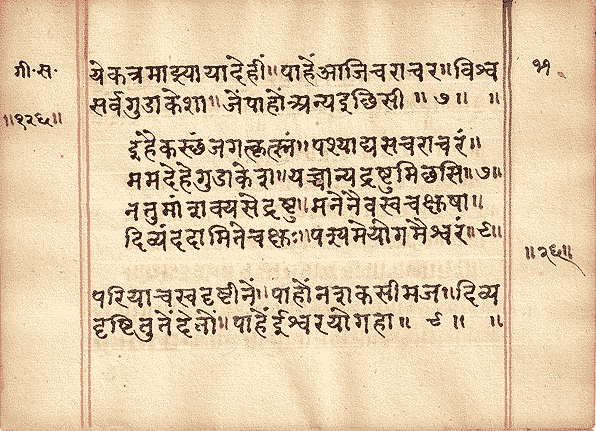
ihaika-sthaṃ jagat kṛtsnaṃ paśyādya sa-carācaram
mama dehe guḍākeśa yac cānyad draṣṭum icchasi
Update RequiredTo play the media you will need to either update your browser to a recent version or update your Flash plugin.
he guḍākeśa (O Guḍākeśa!),
iha (here) mama dehe (in my body) adya (now) [
tvam]
(you) eka-stham (situated in one place) sa-carācaram (with the moving and non-moving [creatures]) kṛtsnam jagat (the whole world) paśya (you must see),
yat ca anyat (and that other which) draṣṭum (to see) icchasi (you desire).
| iha |
– |
av. – here (often meaning: in this world); |
| eka-stham |
– |
eka-stha 2n.1 n.; yad ekasmin sthāne tiṣthati tat – which is situated in one place (from: eka – one; √sthā – to stand, stha – suffix: being in); |
| jagat |
– |
jagat 2n.1 n. – world, moving, mankind (from: √gam – to go); |
| kṛtsnam |
– |
kṛtsna 2n.1 n. – whole; |
| paśya |
– |
√dṛś (to see) Imperat. P 2v.1 – you must see; |
| a-dya |
– |
av. – today, now (from: √div – to shine, dyu – day, heaven); |
| sa-carācaram |
– |
sa-cara-acara 2n.1 n.; DV / BV: yat caraiś cācaraiś ca sahāsti tat – with the moving and non-moving [creatures] (from: sa – together with, in common, short form of: saha or sama; occurs mostly in compounds, requires instrumental; √car –to move, to go, cara – moving, living; a-cara – non-moving, not living); |
| mama |
– |
asmat sn. 6n.1 – my; |
| dehe |
– |
deha 7n.1 m. – in the body (from: √dih – to anoint, to smear, deha – a form, shape, body); |
| guḍākeśa |
– |
guḍākeśa 8n.1 m. – O one with thick hair (from: guḍa – ball, molasses; keśa – hair);
or TP: guḍākāyā īśeti – O lord of laziness (from: guḍākā – laziness, idleness, sleep; √xīś – to own, to reign, īśa – ruler, lord); |
| yat |
– |
yat sn. 2n.1 n. – that which; |
| ca |
– |
av. – and; |
| anyat |
– |
anya sn. 2n.1 n. – other; |
| draṣṭum |
– |
√dṛś (to see) inf. – to see; |
| icchasi |
– |
√iṣ (to desire) Praes. P 2v.1 – you desire; |
kṛtsnaṁ → sarvaṁ (all);
cānyad → cānyaṁ (and the other);
na kevalam etāvad eva—
ihaika-stham ekasminn eva sthitaṃ jagat kṛtsnaṃ samastaṃ paśyādya idānīṃ sa-carācaraṃ saha careṇācareṇa ca vartate mama dehe guḍākeśa | yac cānyat jaya-parājayādi | yat śaṅkase, yad vā jayema yadi vā no jayeyur [gītā 2.6] iti yat avocaḥ, tad api draṣṭuṃ yadīcchasi
iha mamaikasmin dehe, tatrāpi ekastham ekadeśasthaṃ sacarācaraṃ kṛtsnaṃ jagat paśya; yac cānyad draṣṭum icchasi, tad apy ekadehaikadeśa eva paśya
kiṃ ca ihaikastham iti | tatra tatra paribhramatā varṣa-koṭibhir api draṣṭum aśakyaṃ kṛtsnam api carācara-sahitaṃ jagad ihāsmin mama dehe ‚vayava-rūpeṇaikatraiva svitamadyādhunaiva paśya | yac cānyaj jagad-āśraya-bhūtaṃ kāraṇa-svarūpaṃ jagataś cāvasthā-viśeṣādikaṃ jaya-parājayādikaṃ ca yad apy anyad draṣṭum icchasi tat sarvaṃ paśya
na kevalam etāvad eva | samastaṃ jagad api mad-deha-sthaṃ draṣṭum arhasīty āha ihaikastham iti | ihāsmin mama dehe eka-stham ekasminn evāvayava-rūpeṇa sthitaṃ jagat kṛtsnaṃ samastaṃ sa-carācaram jaṅgama-sthāvara-sahitaṃ tatra tatra pariśramatā varṣa-koṭi-sahasreṇāpi draṣṭum aśakyam adyādhunaiva paśya he guḍākeśa! yac cānyaj jaya-parājayādikaṃ draṣṭum icchasi tad api sandehocchedāya paśya
paribhramatā tvayā varṣa-koṭibhir api draṣṭum aśakyaṃ kṛtsnam api jagat | iha prastāva ekasminn api mad-dehāvayave tiṣṭhaty ekastham | yac cānyat sva-jaya-parājayādikaṃ ca mamāsmin dehe jagad-āśraya-bhūta-kāraṇa-rūpe
kiṃ ceha mama dehe eka-stham eka-deśa-sthitaṃ sa-carācaraṃ kṛtsnaṃ jagat tvam adyādhunaiva paśya | yat tatra tatra paribhramatā tvayā varṣāyutair api draṣṭum aśakyaṃ tadaikadaivaikatraiva mad-anugrahād avalokas tvety arthaḥ | yac ca jagad-āśraya-bhūtaṃ pradhāna-mahad-ādi-kāraṇa-svarūpaṃ sva-jaya-parājayādikaṃ cānyad draṣṭum icchasi tad api paśya
